Friday, August 26, 2011

How to Become an Investor Magnet


Martin Soorjoo from Investor Pitch Clinic, shares his thoughts on how to become an investor magnet. He wrote the following:

This is the true story of ‘Ryan’ (not his real name). A serial entrepreneur with no qualifications and a very limited understanding of financials or launching a startup. Ryan, however, is an entrepreneur with a deep understanding of people, who consistently and easily raises hundreds of thousands of dollars from very savvy, experienced investors.

I first came across Ryan six years ago when he approached me to help him create some pitch materials. He explained that he had persuaded 2 investors (both bankers) to invest $500K in his IDEA (no prototype, company or team) but that one of the investors had asked to see details of his business model and financial projections.
Initially, I was sceptical as to whether the potential investors had, in fact, actually committed or had simply expressed an interest in learning more about Ryan’s idea.

Sensing my scepticism, Ryan called one of the bankers on his cell phone, explained I was helping him put together the information that had been requested and asked him to confirm to me that he was investing. Sure enough, banker X confirmed that both he and banker Y were investing but would appreciate understanding a bit more detail. About a month later, Ryan received the investment.

I subsequently helped Ryan raise nearly 2 million dollars over the next two years, though it’s fair to say that my role seemed limited and that all I was doing was effectively confirming, in writing, deals that Ryan had already successfully pitched and negotiated.

Over time, through observation and discussion, I came to understand that although Ryan is a very disorganized, creative entrepreneur, he does use a highly effective ‘system’ for securing investors. This is how Ryan does it.

1. Research – Ryan goes out of his way to identify potential angel investors. Typically these are people who have some capital and are involved in business or finance. Ryan’s research method is real world as opposed to virtual. He is a ‘social butterfly’ continually making new connections and expressing a deep interest in these people and their friends. Slowly but surely, Ryan builds up a picture of those people who are likely to be potential investors.

2. Target Early – Once Ryan identifies his prey (potential investors), he puts himself into situations where he will meet them. This can be anything from the opening of an art gallery to a mutual acquaintances party. Ryan is very determined and resourceful and always seems to find a way to cross the path of his targets.
Ryan doesn’t wait until he is desperate funding. He describes himself as being in ‘perpetual funding mode’. By lining investors up in advance, he effectively ensures that he is able to access investment as and when he needs it.

3. Seduce – Applying the same principles that most of us use to persuade someone to come on a date, Ryan presents his best side to his target. In addition to being upbeat, witty and charming, Ryan expresses deep interest in the potential investor. He makes the encounter about them and makes every effort to ensure they enjoy the experience of meeting him. Far better than pitching an investor at a urinal!
Though Ryan has the same worries and stresses that every entrepreneur does, he never reveals these to his target. He also never talks about his latest venture unless specifically asked. Social protocol means that he is always asked about what he does.

4. Convey Success – Ryan is a master at making dry toast sound mouth- watering. When asked what he does by his targets, he always makes it sound as though he is already successful. While being careful never to mislead, Ryan focuses on the positive and any successes that he has already achieved as well as others who are interested in his venture. Even when talking of potential challenges, Ryan focuses on the solutions.

5. Engage – Having already worked out what makes his potential investor tick, Ryan focuses on those points that are most likely to appeal to them. He always asks for their opinion and lets them know he values it. Importantly, however, Ryan never mentions that he is looking for investment unless pressed by his target.

6. Enchant – In his latest book ‘Enchantment’ Guy Kawasaki discusses the importance of enchantment to business success. Ryan understands this principle well and makes his ‘investor encounters’ magical, mesmerising experiences using the power of story and likeability, while focussing on how his venture will make a difference to the lives of others. If you want to enchant others, I strongly recommend you read Guy’s book.

7. Hook and Leave – Though somewhat counter intuitive, Ryan usually leaves the encounter at the point he is certain his target’s interest is at its high point. This seems to be a variation on ‘playing hard to get’ which tends to have the desired effect with the target making contact a few days later with a request that Ryan let them invest.

Conclusion
Ryan’s way may not be for every entrepreneur. But Ryan has proved time and time again that it works. Even during today’s tough economic climate. Many of the techniques and strategies Ryan’s uses are the very same advocated by Angels and VC’s in their blog posts and elsewhere.

At the end of the day, Ryan is focussing on building relationships. He never misleads anyone but does use his powers of persuasion to maximum effect. People and relationships are the most critical factors in investment. This is why investors consistently say that the team is the most important factor in a deal. It is also why when talking about an investment, investors will often start out by saying that the founder is a great person with lots of integrity.

Source: Investor Pitch Clinic

Saturday, July 30, 2011

Secret codes for ‘Exceeding Expectations’ revealed

This article was taken directly from the software mind mapping expert project manager Babou's blog Leadership Champs. Very effective articulation of organizational behavior. However, Babou forgot the most important final phase of the strategy. Document, Quantify, Present and Evangelize your contributions.


This article explains about factors that lead to exceeding expectation in your activities (either personal or professional). This puts your life in a traffic free express way! After understanding the ‘secret codes’ for exceeding expectation & once you started implementing them then no one can stop your growth by any means!

cloud catching

cloud catching

Whatever be your level in your organization, every time when you hear the word “Exceed expectations” from your manager, do you think it is a kind of cloud catching exercise for you? This feeling will be there when you have confusion on what really needs to be done to exceed expectation.

Just by hearing the term “Exceeding Expectations”, you get the general meaning that “over and above what is expected”. Don’t go beyond this simplest & straight forward meaning. If you start thinking too much about the term, you end up in doing ‘tread mill’ i.e. running in the same place & not going anywhere.

First and foremost step for anyone to exceed the expectation is to know what is expected. Expectations changes from time to time based on performed activities & experience. Expectation level can go down or go up from time to time.

Expected behavior is the grey area which is revealed only during performance review session. This makes the entire process of achieving exceed expectation harder.

When a manager sets expectations it is based on team member’s experience, skill and knowledge in overall work or in a particular task.

When manager decides goals, he documents and communicates only the expected outcome. The expected behavior is not explicitly discussed with team member. During performance review discussions, tug of war happens over the expected behavior as it is mostly subjective in nature.

Manager & team member need to analyze alignment of expectations with the high-level project goals.

Note: Though references in the below text talks about interactions between a team member and a manager, the term ‘expectation’ is applicable to all & not specific to one particular activity, hence you can apply these ideas to any activity. Also, degree of individuals’ skill varies from one person to another & this text doesn’t talk about how they can improve these skills as it is in an individual’s hand.

Exceeding Expectations Mind Map

Exceeding Expectations

Three main factors that decides ‘exceeding expectations’ for an employee (either it is a team member or manager) are – Proactive, Effective, Creating visibility. All three are interlinked as one helps the other and they share certain common elements.

Being proactive is the basic behavior expected on every assigned activity. In many ways you can exhibit this factor –

a) From childhood, we are trained in such a way that we simply wait for instructions. This is real enemy for exceeding expectation. Even you know how to do, if you wait for your manager to tell then it will not bring you up above the expectation level. You need to start performing activities without prompting or at least you can inform your manager that you are doing it.

b) You need to start assuming responsibility in the absence of someone (either manager or peer)

c) As Einstein said “one cannot solve the problems at the same level at which it was created”. You always need to understand the big picture which helps in identifying issues before hand.

d) You need to avoid mistakes either by following existing standards/processes set in the project or by creating your own standards/processes. This gives an excellent way to project you as a disciplined person.

e) Whenever you encounter with a problem, you should not stop at that point and stare at your manager with blank face. You need to move from problem oriented mindset to solution oriented mindset, in that way you can identify & provide possible solutions or workarounds for the situation.

Effectiveness is another important factor that makes you to exceed the set expectations. You can bring effectiveness mainly through practice & disciplined approaches. Here are few areas where effectiveness gives more weightage to expectations

a) In different decision-making scenarios – it can be a decision-making for general solution approach or a strategic decision-making or in an ambiguous/pressure situation. Usually work will be smooth and we encounter ambiguous or pressure situations once in a while, but behaviors shown in those situations has long-lasting effect in the organization history.

b) Effectiveness in activity management has greater value in deciding where you stand in the expectation scale. Following a procedural way in estimating time required, balancing personal & professional life, planning and organizing activities will bring you up in the scale.

c) Communication is integral part of whole expectation cycle from setting it till fulfillment. Effective communication happens when you understand things to be done in one (or few) round of explanation.

d) Others will look at you if you start implementing action items (sometimes it is corrective actions too) as many lacks the skill of following up the action items. In this way you can make yourself stand out in the crowd.

e) Self awareness – Though I mentioned it as last point, but this is having equal credit in securing high score in expectation levels. The one who understood his strengths and weaknesses can perform activities effectively. You help others in your strong areas & get help from others in the weak areas. In this way, you will complete the job within given timelines.

Creating visibility is the third factor for exceeding expectation.

a) Visibility creation is in your hands & it is not in the size of activity that you are performing. You can make everyone look at you the way you do it.

b) You can gain confidence of your higher officials by showcasing goodness in the work you performed & by the way you can also grab new opportunities with that.

c) Again, effective communication decides the level of visibility that you are creating. You need to use every given opportunity as visibility creation test & use your full potential in doing that.

d) Whenever you are included in a discussion or in performing an activity, everyone around you needs to feel value addition you make to that discussion/activity.

e) Having a relationship is not just enough; you need to have a positive relationship that enables you to influence people positively. With positive relationship, your acceptance will be widespread & people will help you without ego or grudge.

*The Forgotten Forth Factor: Document, Quantify, Present and Evangelize your contributions.
Being the "go to guy" who is dependable for getting things done, does not always result in career growth without the forth factor elements.

a) Document contributions: 1. Contribute to company blogs. 2. After every meetings, develop reputation to being the first to send summary of meeting with status, findings, action items and next steps with names to all the meeting participants. Notate sharepoint whenever possible.

b) Quantify contributions: Keep track of your successes, quantify those successes in measurable contribution units.

c) Present contributions: Present your successes by formally present new ideas and recommendations when ever possible, and include your past performance, the measurable contribution units, in the pitch to management and all hands meeting.

d) Evangelize your contributions: Brand your performance and contributions to the organization by discussing your ideas and contributions as one of your passions. If it is your passion, it is expected that you will happily continuously discuss your ideas and contributions; that ultimately results in a reputation. A reputation for exceeding expectation can bring leverage and lift in ones career path.

-------------------

Source: Leadership Champs

Saturday, July 23, 2011

Whose Watching The Banks?


Fiscal Times wrote; Banks are complicated, and especially in this age of too-big-to-fail, they often house a number of thorny practices under one roof – practices that, as we learned the hard way in the fall of 2008, can be difficult to regulate. When the Dodd-Frank Act was passed a year ago, lawmakers and citizens hoped it would usher in a more robust and effective system of oversight. The law created several new regulatory agencies to deal with the challenges of keeping the most complex financial industry in the world in check. These intricately named agencies include the Financial Stability Oversight Council and Consumer Financial Protection Bureau and join a lineup that already boasts the Office of Thrift Supervision and Bureau of Competition.The convoluted system was made more so, and today it can be nearly impossible to keep track of who exactly is overseeing what. To help decode this web of oversight, The Fiscal Times created this infographic, “Who’s Watching the Banks,” to illustrate which agencies – and which agencies within agencies – keep an eye on which aspects of the financial industry.

Do you know whose watching the banks? Do you think there is enough oversight, or is further regulations needed?
----------------
Source: The Fiscal Times

Wednesday, July 6, 2011

How Great Leaders Inspire Action through the art of "Why"

Simon Sinek focuses on the art of knowing "Why". Those who know the answer to WHY in history have been the most effective leaders.

All organizations and careers function on 3 levels:
1. What you do - purpose, cause or belief is ones driving motivation for action.
2. How you do it - ones specific action one takes to achieve "Why".
3. and Why you do it - the tangle ways in which one brings "Why" to life.

The problem is, most don’t even know that "Why" exists. Although, Simon's Martin Luther King root cause analysis was not completely correct, he got the ideas of "Why" correct.


Simon O. Sinek is a thought leader and author best known for developing "The Golden Circle" and popularizing the concept of Why. He works with a variety of leaders and organizations including military, government, corporations, entrepreneurs and charitable organizations. Recognized as an expert in Air Force culture, he joined the RAND Corporation in 2010 as an adjunct staff member, where he advises on matters of military innovation and planning. His first TEDx Talk, "How Great Leaders Inspire Action," is the 19th most viewed video on TED.com. His book on the same subject, "Start With Why: How Great Leaders Inspire Everyone to Take Action," (2009) delves into a naturally occurring pattern, grounded in the "biology of human decision-making", that explains why we are inspired by some people, leaders, messages and organizations over others.
----------------
Source: 2009 Tedx Talks on Leadership

Thursday, June 23, 2011

You don’t have to be a CEO to connect

As leaders, we’re immersed in metrics — perpetually measuring and evaluating business performance and looking for the next improvement. Yet one metric that gets scant attention in some organizations is employee engagement. A 2010 Gallup report finds that 71% of employees are disengaged, up 4% year-over-year. That’s a disturbing number.

However, there’s a one-word, cost-effective solution for bolstering employee commitment: connecting.

Connecting is good for individuals and for business. It’s a little dated, yet back in the late 1990s, Sears discovered that a 5% increase in employee satisfaction produced a 1.3% positive bump in customer satisfaction, yielding a 0.5% increase in revenue growth. How? With leaders transcending “it’s all about me” and instead building connections and relationships.

All work gets done by and through people, so connecting with them should be high on a leader’s priority list, right alongside strategizing, budgeting and planning the next acquisition. As Doug Conant and Mette Norgaard write in “Touchpoints: Creating Powerful Leadership Connections in the Smallest of Moments”: “Each of the many interactions you have during your day is an opportunity to establish high performance expectations, to infuse with greater clarity and more energy and to influence the course of events.”

Besides knowing one’s own strengths and weaknesses, there are three constituencies where fostering real connections (not just clicking a “like” icon!) pays big dividends: One’s own work team, others within the organization and the wider world.

Try one (or more) of these five ways to build meaningful associations with these groups:

  1. Be honest with yourself and with others, and own up to your mistakes. We’ve all seen too many examples lately where leaders lie, cover up and then lose all credibility. Leadership development author John Baldoni offers a helpful nugget for handling these situations: “Demonstrate through words and passion that you have done what you think is best. At the same time, do not be defensive. Act with honest confidence, even when you admit mistakes.”
  2. Be generous with your time. Don’t get caught in the trap of thinking you’re too busy to meet people for coffee, chat for a few minutes after a meeting or take in the occasional networking event. People want affiliation, so be the one who gives it to them.
  3. Take some advice from Tony Schwartz, president of the Energy Project, and view the world through “a reverse lens.” Of course, we want to get the sales report to the boss as soon as we can; yet when a colleague drops in unexpectedly, think of it as an opportunity to engage and influence rather than as an interruption.
  4. Champion and/or adopt others’ ideas. Being open-minded and practicing reciprocity belong on every leader’s playlist. If you want people to play in your sandbox, you must play in theirs from time to time.
  5. Be an information and connection broker. Share information (what you can), introduce people, make recommendations, pass along the names of articles and books, etc. Being viewed as a subject matter expert or the “go-to” person for ideas boost both personal and professional connections.

Make it a practice to connect at least once a day and avoid becoming out of touch and short-sighted by focusing only on short-term tactical situations.

----------------------------

Source: by Jane Perdue, founder of Braithwaite Innovation Group and a leadership and women’s issues consultant. Jane is @thehrgoddess on Twitter and can also be found doing e-learning at Get Your BIG On.


Friday, June 10, 2011

Common Factors Shared by Powerful and Influential Leaders

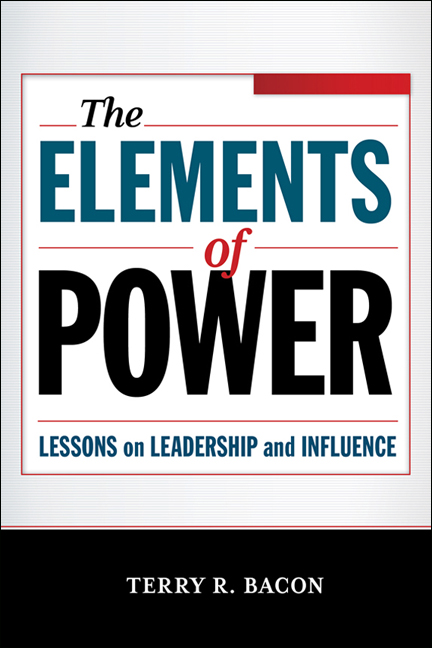
Terry R. Bacon, PhD, a thought leader, renowned consultant, scholar in residence and author of The Elements of Power posted an entry on the Great Leadership blog. Dr. Bacon pointed out common elements shared by powerful and influential leaders.


By TRERRY R.BACON,PhD, author of Elements of Power.

When most of us think about the power of leaders, we think about the legitimate authority that comes with whatever role they play in the organizations they lead. CEOs are powerful because they are the chief executives of their companies; presidents are powerful because they exercise the legitimate authority vested in them by virtue of their position. But it turns out that role authority, while an important source of power for leaders, is not a leader’s greatest source of power; in fact, it’s not even among the top four.

For the past twenty years, I have been studying power and influence among leaders globally, and that research has yielded some surprising findings about where leaders derive their power. First, the old news. Four hundred years ago, Sir Francis Bacon observed that knowledge is power—and he’s right—but it is a foundational source of power, a prerequisite for being in a leadership position. Character is similar. Leaders could not build a followership without being knowledgeable or skilled in ways that are important to followers, nor would people follow them if they lacked character. Knowledge and character are essential sources of power for leaders, but they are hardly distinguishing.

What is news is the importance of attraction, which I define as the ability to draw people to you, to cause them to prefer you to others. It’s based on the psychological principles of similarity and liking. When we like someone or feel similar to them in some way, we are more likely to be influenced by them. So leaders who are more attractive are more powerful. The attraction can be physical but it may also be based on personality, warmth, caring, energy, commitment, or common values. Having these characteristics makes leaders more powerful because they are more appealing to followers. Having an abundance of these characteristics is commonly called charisma.

Another surprising finding is the importance of a leader’s reputation. This power source is based on how leaders are perceived in their communities, whether those communities are business units, companies, tribes, teams, or nations. It goes without saying that a leader’s reputation is critical—just look at Eliot Spitzer before and after news surfaced of his dalliances with a prostitute—but the research shows that leaders with good or very good reputations are more than three times as influential as leaders with average or poor reputations. Being highly thought of is so critical a source of power for leaders that they should do everything they can to protect it. Moreover, a strong reputation has a halo effect—it enhances all of a leader’s other sources of power.

One of the biggest surprises in my research was the effect of a leader’s ability to communicate. I call it expressiveness—the ability to communicate in commanding and compelling ways. It’s the power of eloquence. People with the gift of speech—like Abraham Lincoln, Winston Churchill, and Martin Luther King—are nearly four times as influential as leaders with average speaking ability. Aristotle and Plato understood the power of rhetoric. In fact, they warned against its abuse, and we witnessed that abuse in the hands of another powerful speaker—Adolf Hitler. But when the gift of speech is used ethically, it can build charisma and be an extraordinary source of power for leaders.

The biggest ah-ha from the research was the importance of will power. If you want to be more influential or have more impact as a leader, nothing matters quite as much as your desire to be more powerful coupled with the courage to act. The research shows that people with very high will power are more than ten times more influential than average leaders. Walt Whitman called the power of will personal force—the will to do something when others merely dream or talk about it. Will power—along with attraction, reputation, and expressiveness—is the secret sauce, the magic elixir that differentiates between average leaders and those who become exceptionally powerful.


Terry R. Bacon, PhD, is the author of The Elements of Power. He has been a thought leader, coach, and consultant to global businesses in leadership, management, and interpersonal skills for more than thirty years. In 1989, he founded Lore International Insti¬tute, a widely respected executive development firm recently acquired by the Korn/Ferry Institute, where he currently serves as a Scholar in Residence. For more on Terry and his works, see http://www.terryrbacon.com/ or http://www.theelementsofpower.com/.
------------
Source:"Four Surprising Sources of Leadership",6/7/11, Great Leadership.
The Great Leadership blog are opinions and information on Leadership and Leadership Development by Dan McCarthy.

Thursday, June 9, 2011

When A Career Veers Off Track

By CRAIG CHAPPELOW AND JEAN BRITTAIN LESLIE

Mid-career derailment can happen any time, but in today's economy there is no room for complacency. With job opportunities harder than ever to find, it's a particularly rough time to be fired or demoted or to hit a career plateau. You can reduce your risk for derailment by paying attention to your value and effectiveness and by focusing on interpersonal skills, adaptability, team leadership and bottom-line results.

Based on the Center for Creative Leadership's ongoing study of executive derailment with clients around the world, here are 10 ways to avoid these pitfalls:

Ask for instant feedback. When walking out of a meeting, ask a colleague, "I think that could have gone better – what could I have done differently?" Listen to the response. Don't defend or justify your actions and don't interrupt. Sean Fowler, assistant vice president with insurance company IAT Group in Cold Springs, Fla., uses feedback from his co-workers as a reality check. "You have to develop a bit of a thick skin," Mr. Fowler said. "Once you get past the initial shock, you really come to appreciate it. It's a long-term effort made up of small steps, not a leap."

Increase self-awareness. Become a student of your own behavior. Take stock of how you feel about your work and how you react when you are pushed outside your comfort zone. Explore the values that matter most to you and use them as an anchor during times of change, transition and stress. Amy Gillard, owner and operator of Gillard Enterprises, an event-management business notes that selecting work which is not the right fit will only create challenges with clients down the line. "Self-awareness is key in my business. You have to know who you are and what you have to offer," she said.

Pay attention to organizational culture. To stay aligned with your organization as it morphs and changes over time, you need a clear understanding of the prevailing culture. Analyze how decisions get made and think about the underlying assumptions that guide the organization as it responds to challenges and opportunities.

Use empathy. Your direct reports, your peers and even your bothersome boss are all human beings worthy of your respect. Listen without judging. Take the feelings and perspectives of others into account. Don't use humor inappropriately and always keep private conversations private. You'll end up with stronger relationships.

Learn to listen. Hearing isn't the same as listening. Turn away from your email and concentrate on the person talking to you. Don't be passive. Ask questions to make sure you understand. Stay in the moment and take notes to help you remember key points. Show people you're really hearing them. Air Force Col. Trent Edwards, Commander of the 28th Mission Support Group at Ellsworth Air Force Base, learned to listen differently in response to feedback from his team and his family. He realized he was using a "war zone" mentality in non-war zone settings. With tours in Afghanistan and Iraq, Edwards describes his previous approach as "very action-oriented. Everything was always go, go, go. Now I try to listen with more patience, with an open ear to try to hear what is being said and also what is not being said."

Collaborate. Try to not be the Lone Ranger. Be open and willing to disclose your decision-making process to others, along with important facts and feelings. Your influence and effectiveness will increase.

Deal with problem employees sooner rather than later. If a direct report's behavior or lack of skills threatens the success of your team, confront the problem head on. Don't let it fester. These kinds of problems almost never heal themselves. Document specific shortcomings and either dismiss the employee or create a development plan for improved performance. The cost of carrying poor performers can have a ripple effect across the organization – destroying morale and dragging down productivity.

Delegate authority. Don't keep your employees tied down and stuck in the same roles and responsibilities. Allow them to test their wings. Assign stretch projects you think they can handle. As they prove themselves, increase the complexity of the assignments. Give adequate guidance and follow up to see how they are doing. Debrief shortfalls and use them as a learning opportunity. Above all, acknowledge positive outcomes.

Focus on the task at hand. While it's great to have a development plan and to work on skills you will need down the road, don't forget that your main job is just that – your main job. Organizations value managers who get work done. Focus on what you need to accomplish each day. Bring jobs to a close. Tie up loose ends. Document outcomes. Get closure, and…

Break out of a rut. Learn from the mistakes that you and others make. Stop talking about how things were done in the past. Bring a new idea or solution to the table. Break away from your lunch cliques. Identify a rut you are in and get out of it.

Become known for your skill at adjusting to change, building strong relationships, leading effective teams and getting results. Your colleagues will appreciate it – and you'll reap the professional rewards.

----------------------------
Source: Wallstreet Journal Career Strategies section June 9, 2011